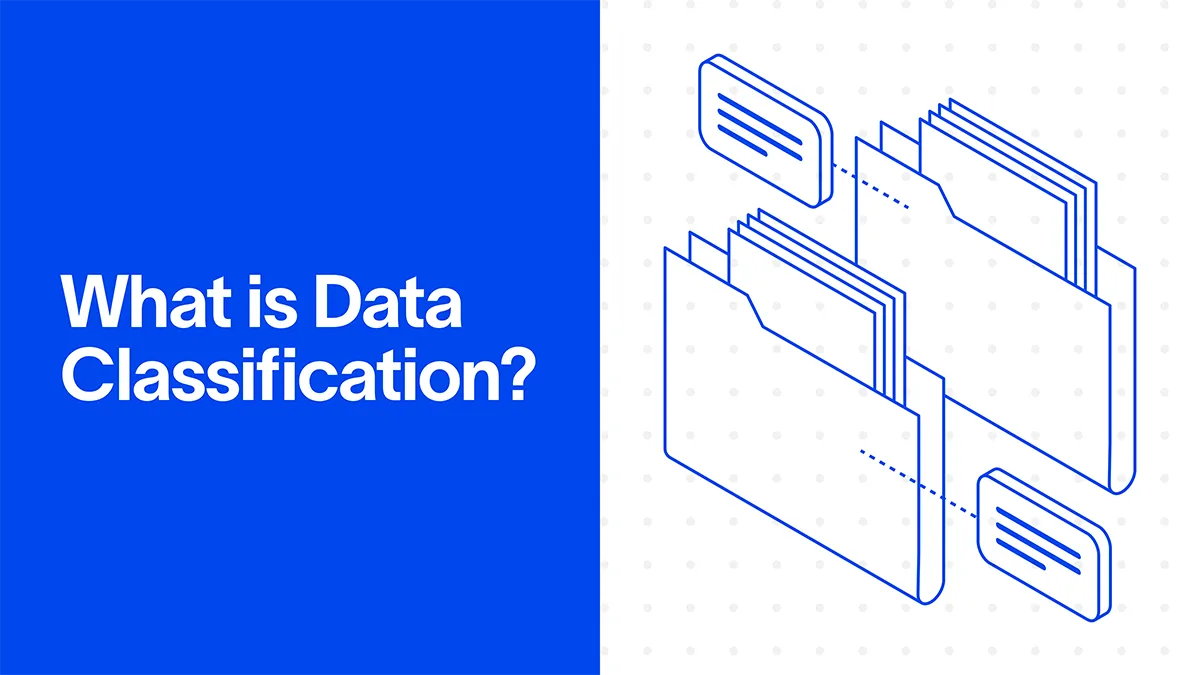
- Data classification is the process of labeling data by sensitivity and risk so that appropriate security controls, access rules, and compliance requirements can be applied.
- Most organizations use three to five classification levels, from public to restricted, with each level triggering a distinct set of handling requirements.
- Classification is the foundation of effective data loss prevention (DLP), data governance, and regulatory compliance programs.
- Unclassified data is ungoverned data: without labels, security teams cannot distinguish a public press release from a file containing customer payment records.
- Cyberhaven DSPM continuously discovers and classifies data across cloud and on-premises environments, giving security teams an accurate, real-time picture of where sensitive data lives.
What Is Data Classification?
Data classification is the process of organizing and labeling an organization's data assets according to their sensitivity, regulatory status, and business value. Labels are then used to determine who can access data, how it must be stored and transmitted, and what security controls apply. Without classification, all data is treated the same, which means sensitive records are either over-protected at great cost or under-protected at great risk.
The practice predates digital computing, as government agencies have classified documents as confidential, secret, and top secret for over a century. Modern enterprise data classification applies the same logic to structured databases, unstructured files, email, cloud storage, and data in transit. What changed is scale. A mid-sized organization today generates and stores more data in a week than its equivalent a decade ago did in a year. Manual review is no longer viable, which is why automated classification tools and data classification software have become a core component of enterprise security programs.
Data classification works in concert with data governance, access controls, and DLP to form the policy layer of a mature security architecture. Classification answers the question "what is this data?" so that every downstream system knows how to treat it.
How Data Classification Works
Data classification moves through three repeating phases: discovery, labeling, and enforcement.
Phase 1: Discovery
Before data can be classified, it must be found. Discovery tools scan repositories, endpoints, email systems, cloud storage, and databases to build an inventory of data assets. Discovery identifies not only what files exist, but where they live, how they are structured, and what types of content they contain. This phase surfaces shadow data, or copies, backups, and orphaned files that no one knew existed.
Phase 2: Labeling
Once discovered, data receives a classification label. There are three main methods organizations use to assign labels:
Most mature programs use a hybrid approach where automated tools handle volume and human review is reserved for edge cases and high-stakes assets.
Phase 3: Enforcement
Classification labels help drive enforcement. A file labeled “Restricted” might trigger automatic encryption, block sharing outside the corporate network, and generate an alert if a user attempts to copy it to a personal device. Enforcement is the mechanism that turns classification into an actual security control. Without enforcement, classification is documentation, not protection.
Types of Data Classification
There are two dimensions to classification of data: the sensitivity level assigned to each asset, and the method used to determine that level.
Data Classification Levels
Organizations typically define three to five data classification levels. The exact names vary by industry and framework, but the structure is consistent.
Some frameworks add a fifth tier, often labeled "Top Secret" or "Highly Restricted," for data whose exposure would constitute an existential business or legal threat.
Classification Methods
Separately from sensitivity levels, organizations choose how classification decisions are made. Content-based classification inspects the data itself. Context-based classification examines surrounding signals (e.g. the application that created a file, the user's role, and the storage location.) User-based classification relies on human judgment. Each method has limitations when used alone, which is why enterprise data classification software typically combines all three.
Why Data Classification Matters for Data Security
When data classification is absent or inconsistent, security programs operate without a foundation. Teams cannot prioritize which systems to protect most aggressively, DLP policies cannot distinguish sensitive transfers from routine ones, and compliance auditors have no evidence that regulated data was handled appropriately.
Compliance and regulatory requirements
Regulations including GDPR, HIPAA, PCI DSS, and CCPA do not simply require that organizations protect certain data, they require that organizations know where that data is and demonstrate that protections are in place. A data classification policy is the mechanism that links data assets to regulatory obligations. An organization that cannot show auditors a classification schema for its PII has a compliance gap, regardless of how strong its technical controls are.
DLP accuracy
DLP tools apply policies based on data labels. A DLP system that cannot distinguish a Restricted customer record from a Public marketing document will either block legitimate work or miss real exfiltration. Classification is what makes DLP policies precise rather than blunt.
Incident response
When a breach or suspected exfiltration event occurs, classification data tells incident responders immediately which assets were at risk and what notification obligations apply. An unclassified environment turns every incident into a discovery exercise, which adds hours or days to containment time.
Common Data Classification Challenges
Stale or inaccurate labels
Classification is not a one-time exercise. Data changes: a document that was Internal last year may now contain customer PII after a merge with another system. Organizations that classify once and never revisit end up with label drift, where the label no longer reflects the actual sensitivity of the content.
Unstructured data at scale
Structured databases are relatively straightforward to classify. The harder problem is unstructured data, such as email, slide decks, PDFs, chat exports, and collaborative documents. Unstructured data typically accounts for the majority of an enterprise's total data volume, and it is where sensitive information most often ends up outside its intended location.
Overly complex schemas
Many organizations design classification schemas with seven, eight, or more levels, often because different business units want their own taxonomy. Complex schemas create inconsistency: employees and automated tools make different judgment calls at the margins, and the result is a label distribution that does not reflect actual risk.
Shadow data and unknown repositories
Data classification tools can only classify data they can find. Orphaned cloud buckets, personal drives used for work, and unauthorized collaboration tools all create shadow IT: sensitive information that exists outside the classification perimeter and therefore outside all downstream controls.
Lack of enforcement integration
A label on a file has no security value unless something acts on it. Organizations sometimes invest heavily in classification tooling but fail to connect labels to DLP, access control, or encryption systems, producing a classification program that is accurate but inert.
How to Implement a Data Classification Policy
A data classification policy is the formal document that defines classification levels, who owns classification decisions, how labels are assigned, and what controls each level triggers. Without a policy, classification programs fragment across business units.
Step 1: Define your classification levels
Start with the minimum number of levels needed to differentiate your data's risk profile. For most organizations, four levels (Public, Internal, Confidential, Restricted) are sufficient. Add a fifth only if a specific regulatory or contractual requirement demands it.
Step 2: Assign data owners
Every data asset needs an accountable owner, meaning a person or team responsible for ensuring it is classified correctly and reviewed on schedule. Data ownership is typically aligned to the business function that generates or uses the data, not the IT team that stores it.
Step 3: Run discovery before labeling
Do not write a classification policy against an assumed data inventory. Run a discovery scan first to understand what data exists, where it lives, and what formats it takes. The results often surface data categories that were not anticipated during policy drafting.
Step 4: Choose your classification tools and methods
Select data classification software that supports the methods appropriate to your data types. Content-based scanning is table stakes. Context-based and behavioral signals become essential as unstructured data volumes grow. Evaluate whether tools integrate with your DLP platform, cloud security posture tooling, and identity management systems.
Step 5: Connect labels to controls
Define the specific technical controls that each classification level activates: encryption requirements, access control rules, DLP policy triggers, retention periods, and audit logging requirements. Write these mappings into the policy document so that enforcement is deterministic, not discretionary.
Step 6: Train employees and maintain the schema
Employees who create and handle data are part of the classification system. Regular training reduces misclassification at the point of creation. Schedule an annual policy review to update levels and mappings as the regulatory environment and data landscape evolve.
How Cyberhaven Addresses Data Classification
Cyberhaven's DSPM integration approaches classification as a continuous, automated process rather than a periodic audit. It discovers data across cloud storage, endpoints, SaaS applications, and on-premises systems without requiring agents or manual inventories, then classifies assets using content inspection and contextual signals drawn from Cyberhaven's data lineage capabilities.
Data lineage tracks data from its point of origin through every copy, transformation, and movement, which means classification is applied not just to where data currently sits but to where it came from and where it is going. This matters because sensitive data rarely stays in the system where it was first created: it moves into reports, gets copied to collaboration tools, and ends up in locations that standard discovery scans miss.
Classification labels from Cyberhaven's DSPM feed directly into DLP policy enforcement, so that rules apply precisely to the data that meets each label's criteria rather than relying on file name patterns or user-declared categories. When an employee transfers a file labeled Restricted to an unapproved destination, Cyberhaven detects the movement and can block, alert, or log it according to policy.
Explore how DSPM can help your organization enhance your data security program with our ebook, “From Visibility To Control: A Practical Guide to Modern DSPM.”
Frequently Asked Questions
What is data classification?
Data classification is the process of organizing data assets into categories based on their sensitivity, regulatory status, and business value. Each category receives a label that determines which security controls, access policies, and compliance requirements apply. The goal is to ensure that the most sensitive data receives the strongest protections, while low-risk data is not burdened with unnecessary controls that slow down legitimate work.
What are the main data classification levels?
Most organizations use four standard data classification levels: Public (no harm if disclosed), Internal (for employees only), Confidential (significant harm if exposed, such as financial data or customer records), and Restricted (severe harm if exposed, such as PII, PHI, or trade secrets). Some regulated industries add a fifth level for data whose exposure would carry criminal or catastrophic business consequences.
What is a data classification policy?
A data classification policy is a formal document that defines an organization's classification levels, the criteria for assigning each level, who owns classification decisions, and what technical and procedural controls each level requires. The policy is the governance layer that makes classification consistent and auditable across business units. Without a written policy, classification decisions vary by team and cannot be demonstrated to auditors.
What regulations require data classification?
GDPR requires organizations to know where personal data is stored and demonstrate that appropriate protections are in place, which classification directly supports. HIPAA mandates safeguards for protected health information (PHI), requiring organizations to identify and protect that data category specifically. PCI DSS requires isolation and monitoring of cardholder data environments. CCPA creates similar obligations for California residents' personal information. Classification is the mechanism that ties data assets to their specific regulatory obligations.
What is the difference between data classification and data governance?
Data classification is one component of data governance. Data governance is the broader program of policies, roles, and processes that determine how data is managed across its full lifecycle, covering quality, ownership, retention, and compliance. Classification specifically addresses how data is categorized by sensitivity and what controls apply to each category. A governance program without classification lacks the sensitivity labels needed to enforce access and security policies accurately.
What should organizations look for in data classification tools?
Effective data classification software should support automated discovery across all data repositories, including cloud storage and SaaS applications. It should offer content-based, context-based, and user-based classification methods, and integrate with DLP, identity management, and cloud security tools. Look for platforms that maintain classification labels as data moves rather than only at rest, and that provide audit trails showing when and why labels were assigned or changed.

.avif)
.avif)